I’ve Been a Designer for 35 Years. Here’s My Advice for the AI Era.
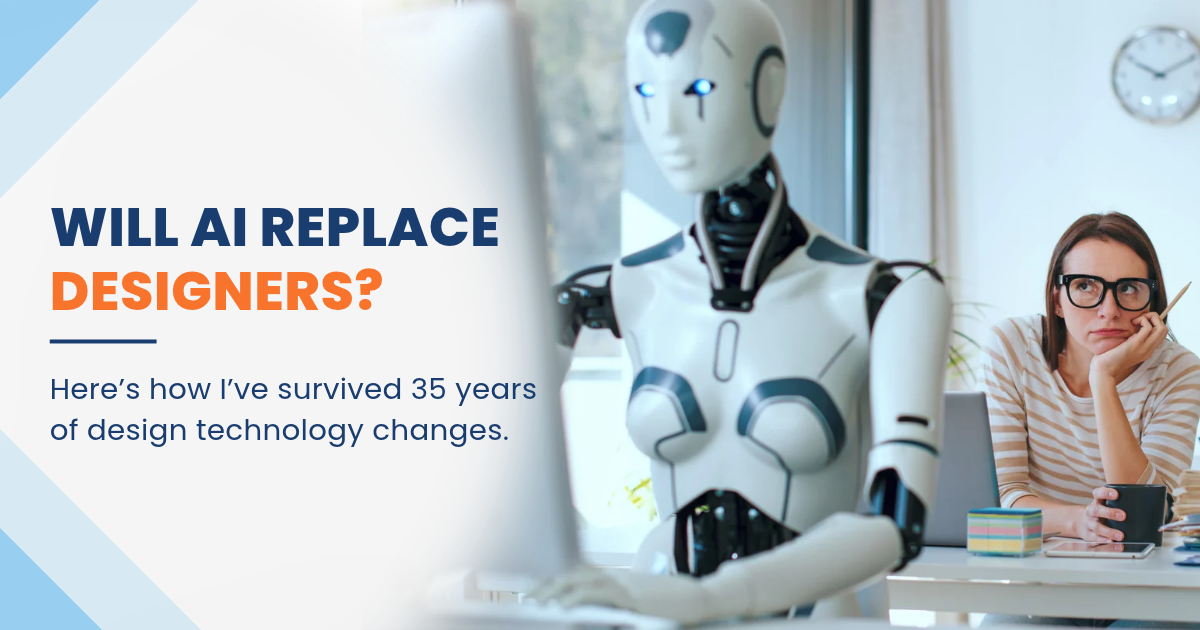
I have been doing design work for 35 years. I started before computers were a part of it all and have worked in newspaper advertising, TV, video, professional printing, and early websites. Now I deliver interactive online training and students frequently ask me about the impact of AI on the design industry.
My personal perspective and best advice is that all industries change. With every innovation, if I wanted to keep being part of the design world, I had to adapt. It has been a fulfilling lifetime journey of constant education. Keep in mind if you enjoy the subject, it feels like an adventure!
Here are my perspectives on the shifts in the design industry driven by AI.
Can AI help or replace web design work?
The most useful distinction I can offer is between production and judgment. AI is genuinely strong at production: generating layouts, writing HTML and CSS, spinning up components, producing ten variations of something in seconds. The parts of web design that are executional and pattern-based are the parts most exposed to automation.
Keep in mind that producing an artifact is not the same as deciding what should be built and why. That second layer is where the work gets hard to automate: understanding users, framing the problem, research, strategy, psychology, communicating a plan to people who disagree with each other, helping people come to a consensus and so on.
Someone still has to sit with a confused business owner and figure out what they actually need/want. Someone has to talk to humans, watch them struggle with an interface, and make sense of messy, contradictory feedback. Someone has to own the decision and defend it. AI can assist all of that, but it doesn't carry the accountability or the human read of a specific room or group of people. We still need people for that type of work.

How can designers stay relevant?
As production gets cheaper, the surviving skills for designers shift toward the human-centered side. Even with AI, designers are needed for their understanding people, making good decisions, and being able to explain parts of the process.
That’s why our design classes include lessons like “Communicating Design Plans,” which is one of the most future-resistant skills in the whole field. AI still can’t compete with humans when it comes to articulating design rationale, aligning stakeholders, explaining a decision clearly, or project and people management.
If I could go back 35 years, what would I tell myself?
If I were a student entering this field now (knowing what I know from the past 35 years), here's roughly how I'd think about it. Learn the fundamentals deeply. Things like classic structures and layout, typography, color theory, and web technologies. fundamentals age slowly. Learn to use AI as a tool rather than competing with it on raw production. The people who thrive will be the ones who direct these tools well, and as you learn, focus on the "why," not just the "how." Build adjacent skills such as communication, research, and understanding the business behind the design. UX study is an area that serves all of this well.
Would I plan to work as a designer "forever" if it's stable?
I feel that permanence is the wrong mindset for any digital field today, not because the field is doomed, but because it will inevitably keep shifting. Design is here to stay and it’s already changed several times over my career. If you build adaptable skills and expect to keep learning, you'll stay valuable even as the landscape moves around you. Also be willing to change how you earn a living with your skills. I started out as a graphic designer, then the internet existed so I had to learn programming languages. Then online automation tools like Canva came to be and my skills were not as needed, so I added consulting and teaching to my career. Keep adapting through it all. That is what it takes to have a lifelong career in any field these days!